



Yesterday I sat in a room at the National Press Club in Washington, D.C. and watched something historic unfold in real time.
The Psychedelic Medicine Coalition brought together a group of people that, not long ago, would have seemed unlikely to share the same agenda: members of Congress, senior officials from the FDA, HHS, NIH/NIDA, and ARPA-H, military and VA leaders, bioethicists, researchers from Johns Hopkins and Yale, investors, care delivery operators, and clinicians. All in one room. All pointing in the same direction.
This is what an inflection point looks like.

The Moment We Are In
Earlier this year, the White House issued an executive order directing federal agencies to accelerate access to psychedelic-assisted treatments for conditions including PTSD, depression, and TBI, particularly for veterans and active-duty service members. It was a signal heard across the field.
But signals need infrastructure. They need science, clinical frameworks, regulatory pathways, trained providers, and delivery systems that can actually reach patients. That's what yesterday was about.
When Rep. Jack Bergman and Rep. Lou Correa opened the day alongside Sen. Tim Sheehy, and when we heard from Matthew Zorn representing the Office of the Secretary at HHS, from the FDA's Center for Drug Evaluation and Research, from Nora Volkow at NIH/NIDA, and from Nathaniel Mohatt at ARPA-H; this wasn't a fringe conversation happening at the edges of policy. This was the center of gravity shifting.
The government is not only watching. It is at the table.
The Power of Working Together
What struck me most about the day wasn't any single panel. It was the full picture of who was in the room and what each of them brought.
Rick Lambert from SAMHSA's Interagency Task Force on Military and Veteran Mental Health sat alongside John Krystal from Yale and RDML James Hancock from the United States Marine Corps. I joined colleagues from Fluence Training, Althea Health, and Palo Santo on the "Healing at Scale: Delivering Psychedelic Care" panel; a conversation about what it actually takes to deliver psychedelic care responsibly and at scale. Researchers and bioethicists filled out the rest of the room.
The afternoon session on Responsible Implementation tackled ethics, liability, and patient safety head-on, with David Yaden from the Johns Hopkins Center for Psychedelic & Consciousness Research and Amy McGuire from Baylor College of Medicine. Exactly the kind of honest, rigorous conversation this field must have in public.
And the Global Report, featuring leaders from the Psychedelic Association of Arizona, Psychedelics Europe, and a Member of the Canadian Parliament, made clear: this is not a uniquely American moment. The world is watching and moving.
None of this works if it stays siloed. Policy without clinical rigor produces bad outcomes. Research without care delivery infrastructure never reaches patients. Care delivery without regulatory clarity operates in the dark. The agenda itself was the argument: this field advances when every part of it moves together.
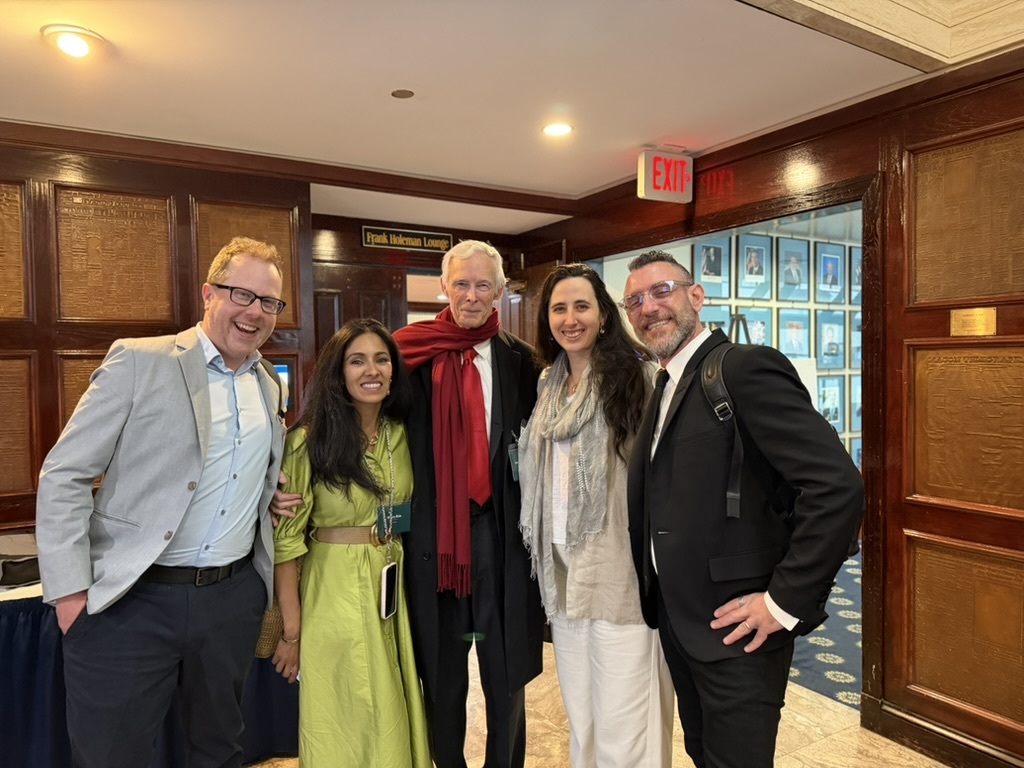
What Journey Clinical Is Building and Why It Matters
I wasn't at the summit as an observer. I was there as an operator; someone who has spent the last several years building the infrastructure this field needs to actually function at scale.
Journey Clinical is the largest psychedelic-assisted psychotherapy platform in the U.S., with a network of 3,000 licensed psychotherapists across approximately 30 states. Together, our clinicians have delivered over 1 million hours of ketamine-assisted psychotherapy to tens of thousands of patients. The outcomes data is compelling: 87% of patients report measurable improvement in clinical outcomes, and 40% report full remission. One thing we've learned from that data is that the full benefit of treatment unlocks with adherence; specifically, 8 dosing sessions paired with preparation and integration psychotherapy.
We are also actively scaling Spravato (esketamine) access, currently building out 20 Spravato clinics to bring this FDA-approved treatment to more patients who need it. And we are building ahead, because the treatments coming through the pipeline will require the same infrastructure, the same trained clinicians, and the same rigorous clinical protocols to be delivered safely.
That's why our research collaboration with Compass Pathways matters. Together, we are working to understand how COMP360 psilocybin treatment, currently in the largest randomized, controlled, double-blind psilocybin clinical program ever conducted, could be delivered to patients at scale if it receives regulatory approval. The work being done in clinical trials means nothing if the delivery infrastructure isn't ready when the approvals come. We intend to be ready.
The community of therapists at the center of this model is not incidental; it is the point. Psychedelic-assisted psychotherapy is a treatment that requires a trained, supported, supervised clinical relationship. Building and sustaining that community is one of the most important things this field can do right now.
Holding the Tension
I want to name something that I think about constantly in this work, and that was present, sometimes spoken, sometimes unspoken, throughout the day.
There is real urgency here. Veterans are suffering. People with treatment-resistant mental health conditions have been waiting decades for options that work. The promise of psychedelic-assisted psychotherapy is not hypothetical; the evidence base is growing, the clinical outcomes are documented, and patients and families are asking for access now.
And yet: moving fast without moving carefully is how we get this wrong.
The history of psychiatry is not without cautionary chapters. The hype-and-crash cycle, where promising treatments get rushed, overpromised, and then discredited, is a real risk that everyone in this field should take seriously. The conversation about responsible implementation, bioethics, and rigorous clinical standards is not the enemy of patient access. It is the condition for it.
Boldness and thoughtfulness are not opposites. They are what this moment requires simultaneously.
Key Takeaways
Find common language grounded in evidence:
One of the most important things this field can do right now is move the public conversation, and the clinical conversation, away from the poles of hype and fear and toward something more useful: honest, rigorous, evidence-based education about what these treatments are, what they can do, what the risks are, and who they are and are not appropriate for. A good place to start is a shared glossary of ketamine-assisted psychotherapy; common language that clinicians, patients, and the public can actually use. Patients deserve that. Providers deserve that. The market needs it to mature in a healthy direction.
It takes a village, and everyone is needed:
Policy advocates, researchers, clinicians, ethicists, care delivery operators, investors, veterans, patients, regulators; this is not a field where any one constituency can carry it forward alone. What I witnessed yesterday was what coordination looks like in practice. It's imperfect and it's hard, but it is the only path that works.
Call your legislators and regulators:
I mean this literally. The FDA, SAMHSA, NIH, and ARPA-H are not monoliths; they are people working within systems that respond to input. Engage with the comment processes. Participate in listening sessions. Build relationships with the agencies that are already leaning in. The window for shaping how this field develops with rigor and care is open right now.
The Time Is Now
I left Washington yesterday feeling something I don't always let myself feel in this work: genuine optimism.
Not naïve optimism. The road ahead involves real complexity; regulatory pathways that don't yet fully exist, training and workforce questions that are nowhere near resolved, access and infrastructure challenges that won't solve themselves.
But the people who need to be building those solutions were in the same room yesterday, speaking the same language, moving with the same urgency.
That's everything.
Related Articles
- Journey Clinical Welcomes Federal Action to Accelerate Access to Evidence-Based Psychedelic Treatments
- Journey Clinical and Compass Pathways Announce Research Collaboration for Psilocybin Treatment Delivery
- Journey Clinical Launched a Nationwide KAP Therapist Directory — Here's Why It Matters
- Glossary of Ketamine-Assisted Psychotherapy (KAP)
For Therapists
Ready to bring ketamine-assisted psychotherapy into your practice? Learn how Journey Clinical supports licensed therapists with the medical infrastructure, collaborative care, insurance pathways, ongoing training and community - all you need to offer KAP with confidence. Book a Demo →
For Patients
Looking for a KAP therapist near you? Browse our network of trained, licensed therapists offering ketamine-assisted psychotherapy across the country. Find a Therapist →