


Your first Spravato session is sitting on the calendar. You've spoken with your provider, you understand the basics — and you might still be wondering: what will this actually feel like? What do I need to do to prepare? What happens when I get there?
This guide walks through everything you need to know before, during, and after a Spravato session — including how it differs from ketamine-assisted psychotherapy (KAP), and why the therapy that surrounds your sessions is just as important as the medication itself.
If you're looking for a Spravato treatment site, find a Journey Clinical Spravato center near you.
What Is Spravato — and Who Is It For?
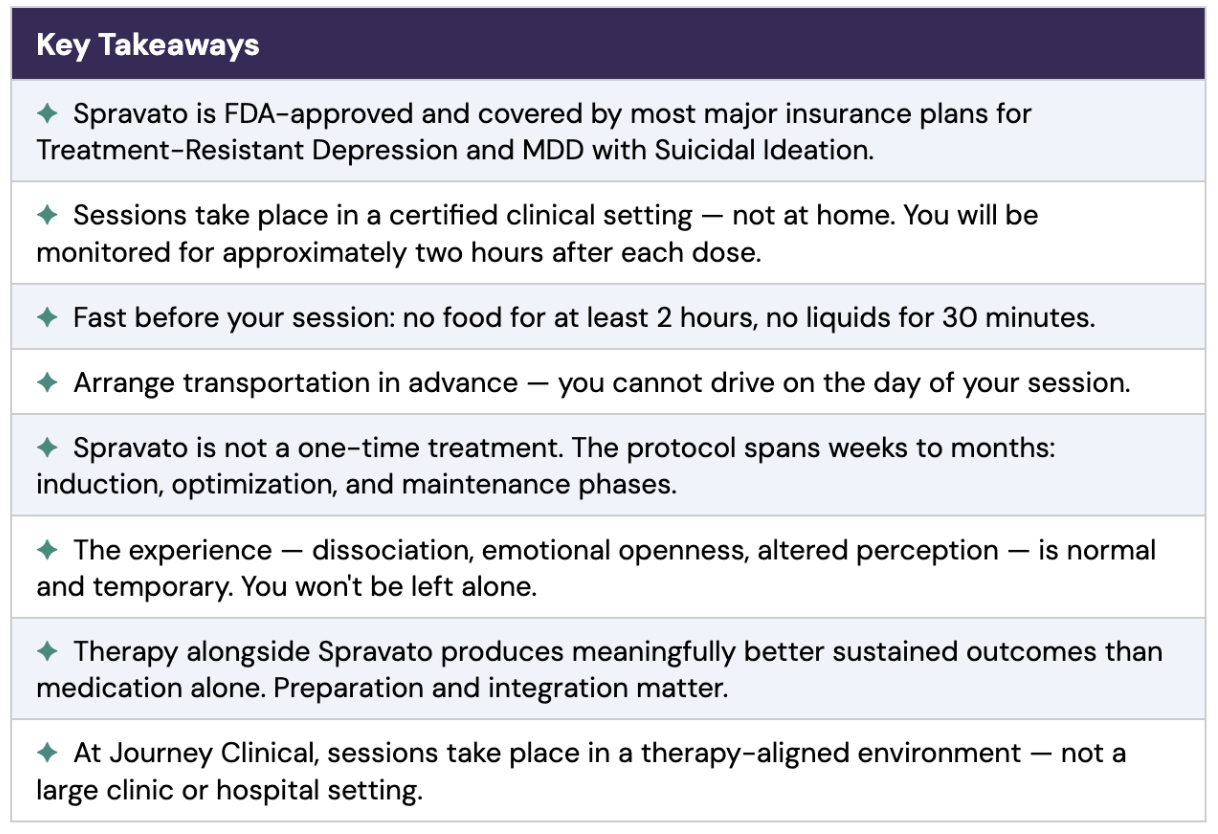
Spravato is the brand name for esketamine, an FDA-approved nasal spray for adults with Treatment-Resistant Depression (TRD) or Major Depressive Disorder with Acute Suicidal Ideation or Behavior (MDD with SI). It is covered by most major insurance plans, including Aetna, Anthem, Blue Cross Blue Shield, Cigna, Optum, and UnitedHealthcare.
Unlike conventional antidepressants that primarily work on serotonin, Spravato works through the glutamate system — specifically as an NMDA receptor antagonist. It increases neuroplasticity and creates greater emotional and cognitive flexibility. Many clinicians describe its effect less as symptom suppression and more as softening of rigid patterns — which is why it can create relief for people who haven't responded to standard treatments.
To be eligible for Spravato, you must meet one of two FDA-approved indications:
- Treatment-Resistant Depression (TRD) — meaning you have not responded adequately to at least two antidepressant trials
- Major Depressive Disorder with Acute Suicidal Ideation or Behavior (MDD with SI) — for adults who need rapid symptom reduction
As of 2025, you no longer need to be on a concurrent antidepressant to receive Spravato. The FDA approved Spravato as a monotherapy in January 2025, removing a barrier that had previously limited access for some patients.
Not sure if you qualify? Find out if you're a Spravato candidate at Journey Clinical.
Spravato vs. Ketamine-Assisted Psychotherapy (KAP): What's the Difference?
Both Spravato and ketamine-assisted psychotherapy (KAP) use ketamine as a vehicle for therapeutic change. But they are meaningfully different in how they're delivered, who they're for, and what the patient experience looks like. Here's a side-by-side:
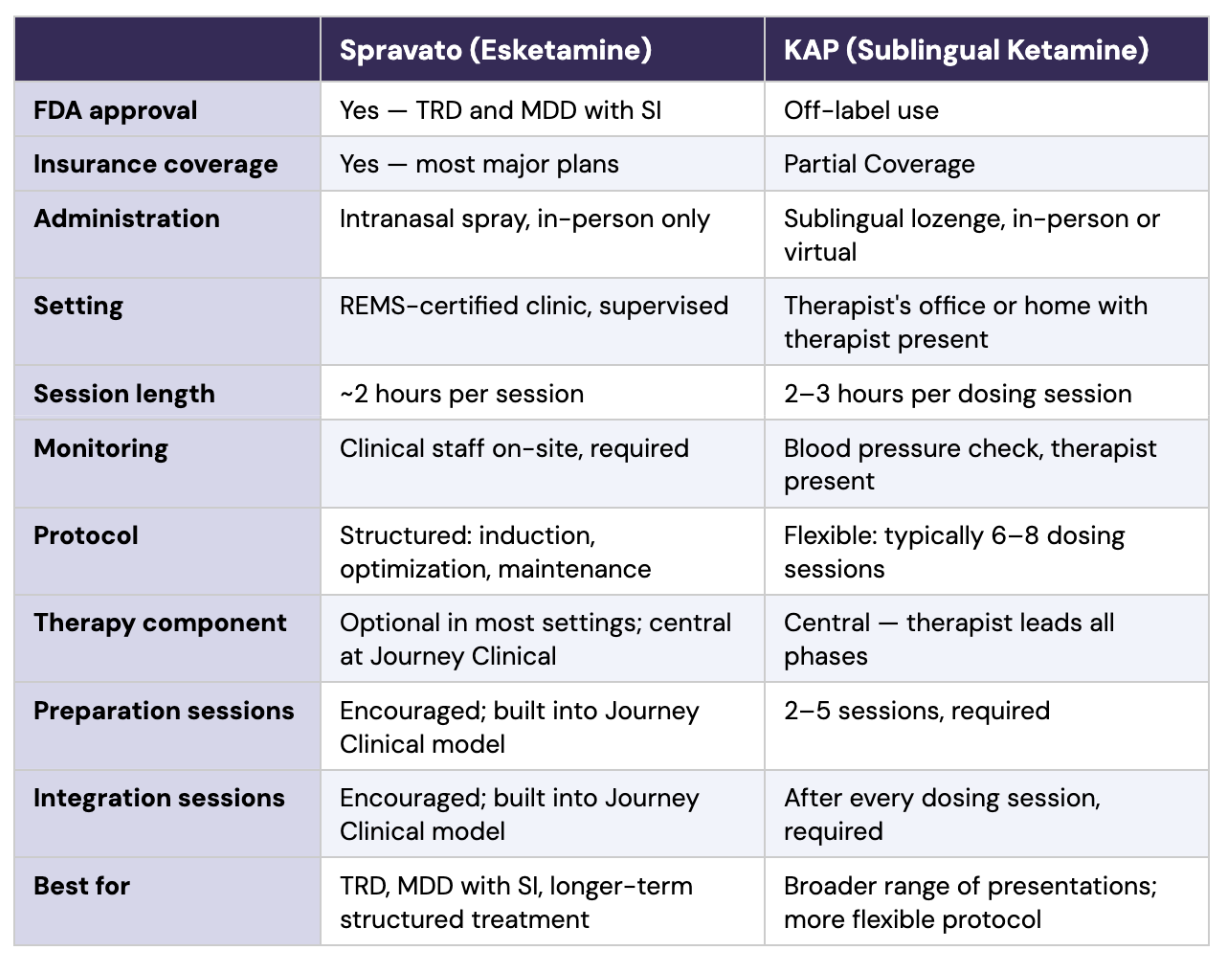
The short version: Spravato is an FDA-approved, insurance-covered pathway — best suited for clients with TRD or MDD with SI who need a structured, longer-term treatment protocol. KAP using sublingual ketamine is more flexible in terms of setting, dosing schedule, and clinical presentation. In KAP, ketamine is prescribed off label, and a portion of the treatment, including medical consultations and psychotherapy sessions, are covered by insurance.
At Journey Clinical, both modalities are offered within a therapy-aligned model — meaning preparation, integration, and ongoing therapeutic support are built into the process, not treated as optional.
The Spravato Treatment Protocol: What to Expect Over Time
Each session includes self-administration of the nasal spray under clinical supervision, followed by approximately two hours of monitoring before you're cleared to leave. Because Spravato can cause dissociation, sedation, and transient blood pressure elevations, it must be administered in a REMS-certified setting — it cannot be prescribed for home use.

Where do Spravato sessions take place?
At Journey Clinical, sessions take place in a therapist's private office or a dedicated healing space — not a large clinic or hospital. Sessions are calm, quiet, and intentional.
These therapists' office are intentionally designed to support your healing, comfort, and safety. As one therapist shares,
"It ends up feeling much closer to a supportive healing environment than what people might imagine when they hear 'monitored medical treatment.'"
— Erica Sandoval, LCSW, Founder of Casa Wellness, a Journey Clinical Spravato site
How to Prepare Before Your Spravato Session
Preparation for Spravato has two layers: the practical logistics that keep you safe on session day, and the psychological and therapeutic preparation that shapes the quality of your experience. Both matter.
Practical Preparation: What to Do the Day Of
- Food: Fast for at least 2 hours before your session
- Liquids: Stop drinking liquids at least 30 minutes before your session to reduce the risk of nausea
- No alcohol or substances: Skip alcohol and recreational substances on session days — these can interfere with how your body responds to Spravato
- Medications: Take your other prescribed medications as normal unless your provider instructs otherwise
- Comfortable clothing: Wear loose, comfortable clothing — ketamine can temporarily increase sensitivity to tight or rough fabrics
- Arrange a ride: Spravato will temporarily impair your coordination and judgment — you cannot drive yourself home. Arrange a ride in advance and plan for a quiet afternoon with no demanding obligations
- Clear nasal passages: Blow your nose gently before your first dose to ensure clear nasal passages. Do not blow your nose after administering Spravato
- Nasal sprays: If you use a steroid nasal spray (like Flonase) or a decongestant nasal spray, use it at least one hour before your Spravato session
What to Bring
- A comfort object — a blanket, headphones, music playlist, book, or anything that helps you feel settled and at ease
- A list of all current medications and supplements to share with your care team
- Any questions you haven't had a chance to ask your provider yet
- A charged device to coordinate with your ride home
Psychological and Therapeutic Preparation
At Journey Clinical, preparation is built into the treatment model — not an afterthought. Before your first dosing session, you'll work with your therapist to:
- Understand what to expect — how the medication will feel, what's normal, what to do if you feel disoriented or anxious
- Set an intention — not a fixed goal, but an open orientation toward what you want to explore or move through
- Practice grounding techniques you can return to if the experience feels intense
- Discuss your history and any relevant clinical context your care team should know about
Setting an intention before a Spravato session is one of the most consistently useful things patients report. It doesn't need to be profound. Something as simple as 'I want to approach this with curiosity' or 'I'm open to whatever feels important' can function as an anchor during the experience.
A 2025 retrospective study published in the Journal of Psychopharmacology found that patients receiving ongoing psychotherapy alongside Spravato showed stronger sustained improvement — particularly beyond the 90-day mark. Preparation is where that therapeutic work begins.

What Happens During a Spravato Session
When you arrive, a clinical team member will check you in and take your vital signs — blood pressure and heart rate — before you receive the medication. This takes only a few minutes and is a standard safety measure, since Spravato can temporarily elevate blood pressure.
The session typically unfolds like this:
- You settle into a comfortable reclining chair or setup in a calm, quiet room. Soft lighting is common. You may bring headphones or music.
- You self-administer the nasal spray under clinical supervision. Your provider guides you through proper technique. If your full dosage requires more than one device, you'll wait five minutes between doses.
- The medication takes effect within minutes. Effects typically peak between 40 minutes and one hour. The subjective experience — which may include dissociation, emotional openness, altered perception, or dreamlike sensations — usually lasts less than two hours.
- Clinical staff are present throughout. Your blood pressure and wellbeing are monitored during the observation period. You are not left alone.
- After approximately two hours, your care team will assess your vital signs and confirm you are ready to be discharged. You will need your arranged ride to take you home.
The experience varies from person to person. Some patients describe feeling emotionally open, reflective, or lighter. Others describe a temporary sense of floating, heaviness, or mild dissociation. Some doze off. All of these are normal. There is no 'right' experience — and no performance required.
"It's really like a veil had lifted. I am in a better place now than I have been maybe ever. And I think that's an amazing gift."
— Grace, Spravato patient
"Some days I would just collapse in a fit of crying, on only 5 hours of sleep a week. With Spravato, I was learning to love myself each and every session — and I'm really proud of where I am now."
— Ben, Spravato patient
After Your Spravato Session: Integration and What Comes Next
The work doesn't end when your session does. What happens in the hours and days following a Spravato session is where much of the therapeutic value is either captured or lost.
Immediately After
- Do not drive or operate machinery for the rest of the day
- Plan for a quiet afternoon — not social events, demanding meetings, or stressful obligations
- Eat something light and stay hydrated once you're home
- Rest if you feel tired. Many patients feel a sense of calm or emotional openness in the hours following a session.
If hard or emotional content came up during the session, try not to immediately push past it. Note what arose. Be kind with yourself. This is material worth bringing to your therapist.
Integration: Where the Work Becomes Lasting Change
Spravato may create emotional and cognitive flexibility — a window of opportunity during which the brain is more receptive to new patterns, insights, and ways of relating. Integration is what determines whether that window becomes lasting change.
Ketamine increases neuroplasticity — the brain's capacity to form new connections — for approximately seven days following a session. This is not a passive process. It is a window that closes. What you do with that time, in therapy and in life, shapes what gets encoded.
Integration at Journey Clinical includes:
- Ongoing psychotherapy sessions with your therapist — focused on processing what came up, connecting it to your patterns and history, and identifying what you want to carry forward
- Reflecting on the experience — noting what stood out, what felt significant, what felt confusing
- Bringing insights into daily life — not forcing dramatic change, but noticing small shifts in perspective, relationships, and self-understanding
Integration does not have to mean a single debrief session immediately after dosing. Meaning often unfolds over days and weeks. Many patients notice that insights from a Spravato session surface gradually — in a conversation with a partner, in a moment of unexpected calm, in a pattern they suddenly see differently.
"Ketamine doesn't create intimacy. It creates flexibility. And that flexibility makes it easier to access emotion, reduce shame, feel safer in your body. Then the therapy helps you use that window to build new patterns and maintain them."
— Brigitte Gordon, DNP, PMHNP-BC, Clinical Director, Journey Clinical
Insurance Coverage and Cost: What to Know
One of the most meaningful things about Spravato is what it doesn't cost. Spravato is covered by most major commercial insurance plans, Medicare and Medicaid, for its FDA-approved indications - TRD and MDD with SI.
Through the SpravatoWithMe patient assistance program, some commercially insured patients may qualify for sessions at approximately $10 per session. In some cases, depending on coverage and eligibility, treatment may be available at no cost.
Journey Clinical handles insurance verification, benefits checks, and prior authorization on behalf of patients — so you don't have to navigate that process on your own.
Find a Journey Clinical Spravato center and begin the eligibility process.
Frequently Asked Questions About Spravato
What is Spravato used for?
Spravato is FDA-approved for two indications: Treatment-Resistant Depression (TRD) in adults who have not responded to at least two antidepressant trials, and Major Depressive Disorder with Acute Suicidal Ideation or Behavior (MDD with SI) in adults who need rapid symptom reduction.
How is Spravato different from ketamine infusions?
Spravato is a nasal spray containing esketamine (the S-enantiomer of ketamine), administered in REMS-certified settings. IV ketamine infusions use the full racemic ketamine compound and are not FDA-approved for psychiatric indications. Spravato is covered by most major insurance plans; IV ketamine is typically not.
What does the Spravato experience feel like?
Most patients describe some degree of dissociation, emotional openness, or altered perception during the session — a temporary loosening of habitual thought patterns. Some feel calm or dream-like. Some doze off. Effects typically peak within 40–60 minutes and resolve within the two-hour monitoring window. You won't be left alone.
Do I need to be on an antidepressant to take Spravato?
No. As of January 2025, the FDA approved Spravato as a monotherapy, meaning concurrent antidepressant use is no longer required. This has expanded access for patients who are not currently tolerating antidepressant medications.
Can I continue seeing my therapist while doing Spravato?
Yes — and this is strongly encouraged. Research shows that patients receiving ongoing psychotherapy alongside Spravato have meaningfully better sustained outcomes than those receiving the medication alone. Journey Clinical's directory of therapists can help you find a licensed mental health professional who is trained in working with ketamine to support you with preparation and integration sessions.
How many Spravato sessions will I need?
The initial protocol includes an induction phase (two sessions per week for four weeks), followed by an optimization phase (once weekly for weeks 5–8), and a maintenance phase (once weekly, with some patients spacing to every other week). Treatment duration varies based on individual response and clinical presentation.
Is Spravato covered by insurance?
Yes, for its FDA-approved indications. Most major commercial plans — including Aetna, Anthem, Blue Cross Blue Shield, Cigna, Optum, and UnitedHealthcare — cover Spravato for TRD and MDD with SI. Through the SpravatoWithMe program, eligible patients may pay as little as $10 per session.
How do I find a Spravato center near me?
Find a Journey Clinical Spravato center near you. Journey Clinical sites are located in therapy-aligned settings — private offices and healing spaces, not large clinics or hospitals.
Spravato is one of the most significant developments in treatment-resistant depression care in years — not because of the medication alone, but because of what becomes possible when it's delivered within a genuine therapeutic model. Preparation, a supportive environment, and ongoing integration are what make the window it opens into lasting change.
If you or someone you know might be a candidate, learn more about Spravato at Journey Clinical or get matched with a provider.